
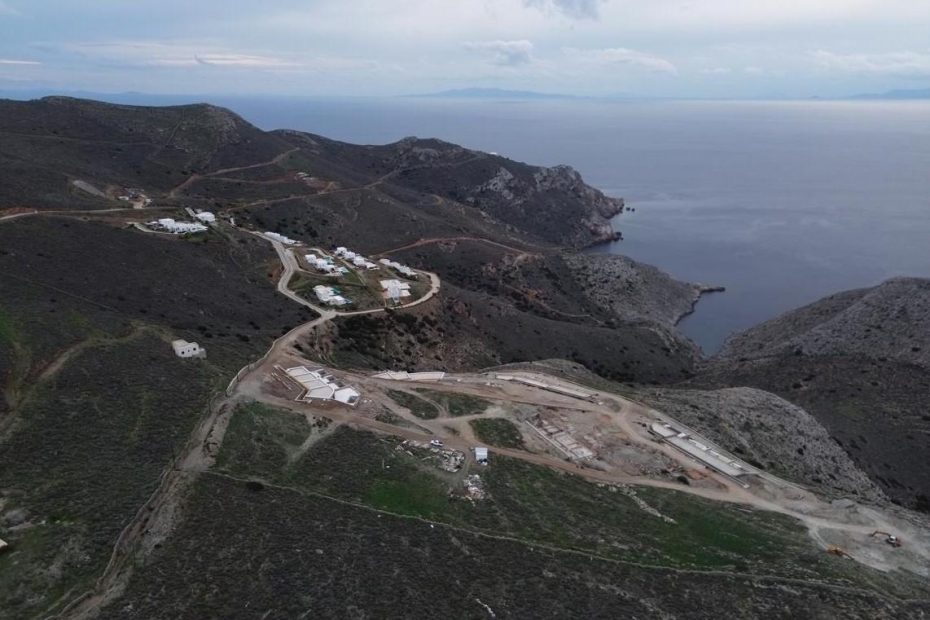
In Charassona—one of the last undeveloped and “virgin” corners of southern Syros—large-scale tourist construction projects are now in full swing: dozens of luxury holiday villas, swimming pools, hotels, spas, landscaped outdoor areas, roadworks, and parking facilities. These interventions are already distorting the landscape and threaten to permanently alter the character of the area.
This mass redevelopment effectively amounts to the de facto creation of an entirely new settlement, built through unregulated urban sprawl. Private real estate interests are gradually assembling a residential complex—opening roads, securing dozens of building permits, and constructing across the entire area. For one segment of the development plan, the company HELLENIC TRADITIONAL HOUSES S.A. has applied for inclusion under the “strategic investment” regime (via the Hellenic Company for Asset Development and Utilisation, HCAD) to build a large-scale tourist complex. This would include: A 166-bed hotel and 69 furnished tourist residences (FTRs) with a capacity of 249 beds, a total built-up area exceeding 20,000 sq m on a 531,251 sq m plot—allegedly formed by the “consolidation” of 56 (!) separate land parcels.
The entire project lacks environmental licensing—specifically, an Environmental Impact Assessment (EIA) and an Approved Environmental Terms Decision (AETD). In plain terms, no comprehensive evaluation has been conducted on the implications of a development of this scale for: water supply and wastewater management, waste disposal, traffic and public safety, landscape and natural ecosystems, nor have binding, enforceable protective conditions been established before construction began.
How were Environmental Safeguards bypassed? Formally, the works are presented as discrete, independent projects, each with its own building permit. In reality, they form a single large-scale development that has been administratively fragmented into multiple approvals. What’s more? the entire construction zone lies outside any approved urban plan while the plots under development lack direct access to a public road—they are “blind” parcels (i.e., landlocked, with no legal frontage). This raises serious questions about the legality of both the buildability of the plots and the issuance process for the permits.
A construction project of this magnitude in Charassona entails—among other consequences—the permanent destruction of one of the last remaining “islands” of the Cycladic ecosystem, an area of exceptional natural beauty (even The draft Local Urban Plan (LUP), published for public consultation by the Ministry of Environment, acknowledges the region’s ecological value: most of Charassona is designated a “Landscape Protection Area”, where all construction is strictly prohibited.
For all these reasons, the Environmental Quality Observatory of Syros filed an Application for Annulment before the Council of State (Fifth Chamber) and both an Application for Annulment and an Application for Suspension before the Piraeus Administrative Court of Appeal.
We call for:
- The annulment of the construction permit for the “integrated tourist complex” in Charassona,
- The revocation of all building permits issued by the Syros-Ermoupoli Urban Planning and Building Authority or the area, and
- The immediate suspension of all construction activities under these permits, pending a ruling on the Application for Annulment.
Our case centres on four key violations:
- Lack of an Environmental Impact Assessment (EIA) and Approved Environmental Terms Decision (AETD)—a flagrant breach of environmental law.
- Contradiction with the draft Local Urban Plan (LUP)—the development violates land-use designations currently under finalisation.
- Illegal parcels without public road access—the plots lack the required frontage (“prosōpo” in Greek planning law) to a public thoroughfare, rendering them unbuildable by definition.
- De facto private urban planning—the project constitutes an unregulated settlement expansion, bypassing statutory spatial planning.
Syros can no longer endure the predatory advance of real estate speculation into its untouched landscapes. We demand: Transparency in planning decisions, strict enforcement of the law, and genuine protection of the island’s landscape and natural resources—for the benefit of society and future generations.
Ermoupoli 11.02.2026
The Board of Directors

