
The municipal authorities responsible for tree pruning on Syros persist relentlessly in their work, repeatedly mutilating the island’s trees. Our association has made significant efforts to halt this destructive practice. Despite our repeated written appeals—one of which we also forwarded to the Syros First Instance Prosecutor’s Office—and our attempts to demonstrate that this practice ruins the trees and makes them hazardous, we have unfortunately failed.
Setting aside entirely the matters of aesthetics and love for greenery—both of which, no matter how you approach them, remain subjective—we must once again emphasise that the new growths of branches following such mutilation are vulnerable to infestations and structurally weaker. This means that the new branches, combined with the ever-present winds on Syros, become lethal hazards. Potential breakages are entirely foreseeable.
In our documents we have cited a number of scientific sources that demonstrate the destruction and danger caused by these practices: the Geotechnical Chamber of Greece, the Greek Technical Specification ELOT IT 1501-10-06-04-01:2009 for “Tree pruning”, the Ombudsman, the guide for pruning using scientifically recommended methods “European Tree Pruning Standard” supported by the European Commission, the research and educational association of tree professionals, the International Society of Arboriculture (ISA), scientists such as the honorary professor of Forestry at Aristotle University of Thessaloniki, Mr. Theocharis Zagas, the vice-president of the Panhellenic Union of Foresters and Natural Environment Managers, etc.
On the part of the Municipality, no scientific source has been presented to support the claim that severe cutting (lopping/topping) protects trees or does not degrade their structural strength. Instead, it is being said that “the Municipality has an agronomist who knows what they are doing.”
We are not biased, and we expect the “agronomist” or whoever in the Municipality is making the decision to mutilate the trees, to indicate the scientific sources on which they rely. And they should certainly be prepared for the possibility that a branch from a mutilated tree could kill someone. They have been warned.
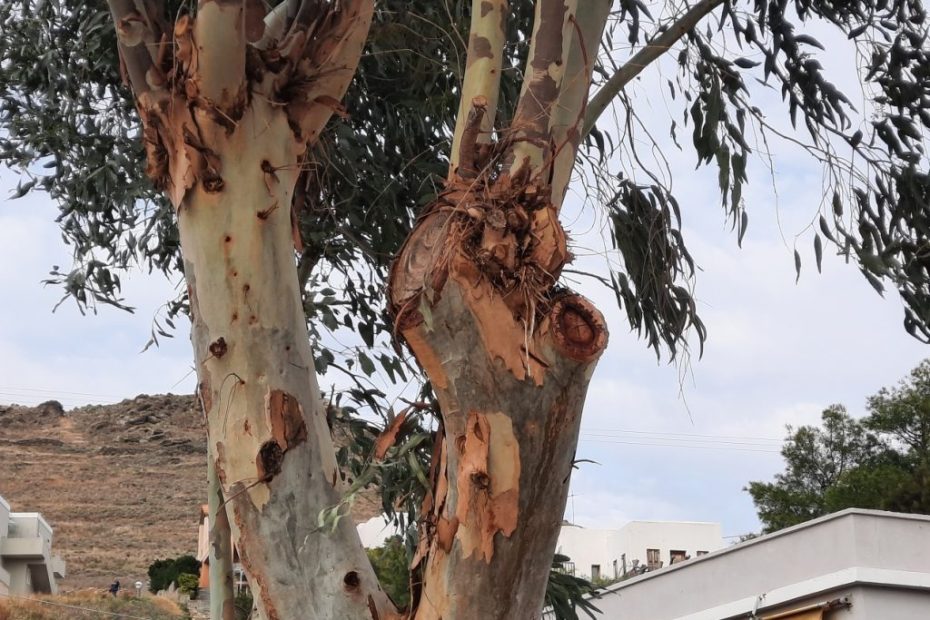
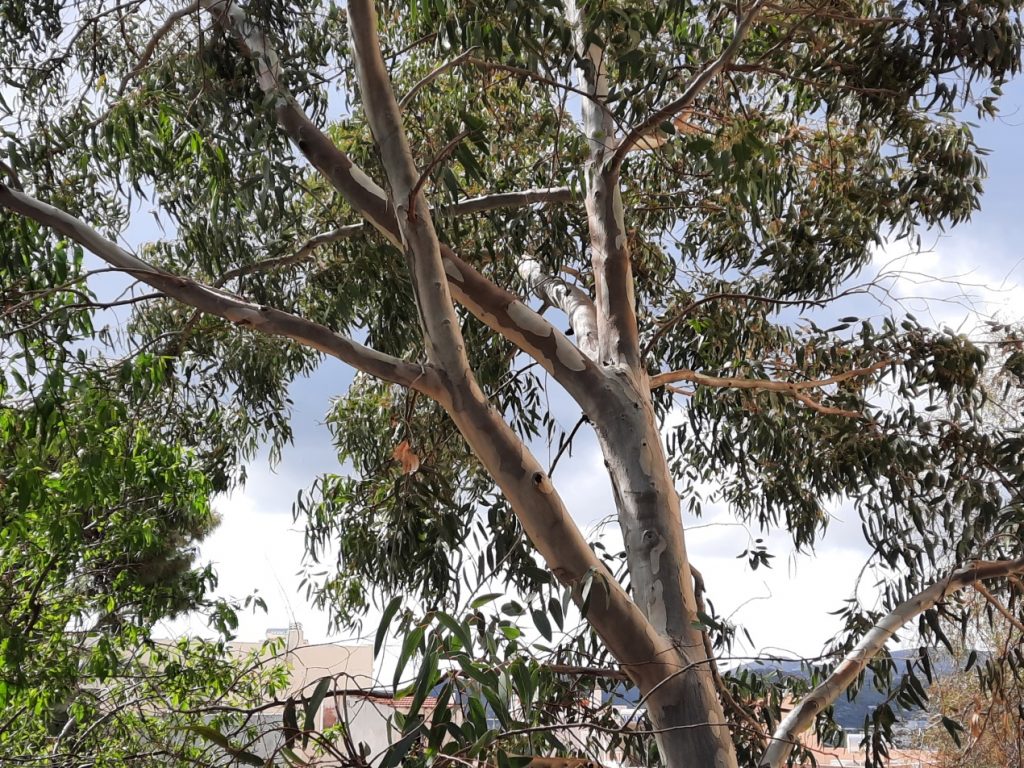
In one photo, a healthy, intact eucalyptus tree is shown, which has escaped the “slaughter,” while in the other, a cluster of branches is shown that results after mutilation (severe cutting). One does not need to be an engineer to recognize the difference and the danger.
The only response the Municipality could give would be: “Yes, we damaged the trees with the initial mutilation, and now the only way to limit their danger is to keep cutting them back periodically.”
For details, please refer to our documents:
and
‘Our unanswered requests regarding the massive amputations of trees and other destructive actions for vegetation in Syros and the submission of additional data’ (ref. 265/30.03.2023)
13.03.2026
The Board of Directors

